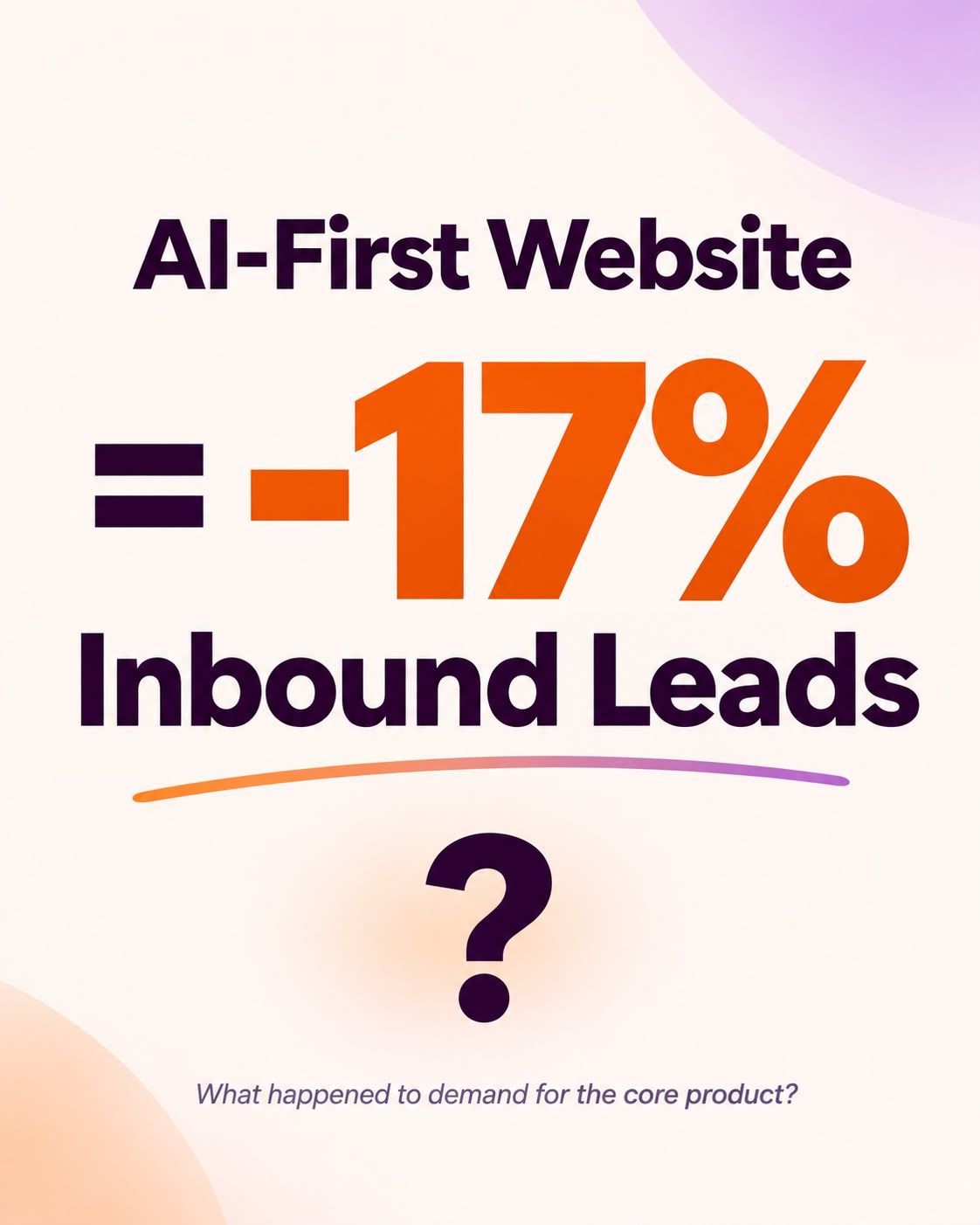
They Put AI Front and Center on Their Website. Inbound Leads Dropped 17%.

Idan ArealyCo-Founder & CEO, Propello
Redesigning a website around AI can cost a company the buyers who came for its core products. One cybersecurity company doing over $100M in ARR put its new AI capabilities front and center and saw a 17% drop in inbound leads. Prospects looking for the traditional products couldn't easily find them, so they left.
Yesterday, we onboarded a cybersecurity company doing over $100M in ARR.
What made this onboarding interesting wasn't their size. It was why they came to us.
Key takeaways
- A cybersecurity company doing over $100M in ARR redesigned its website with a clear "AI-first" message. The result was a 17% drop in inbound leads.
- Their explanation: prospects looking for their traditional core products couldn't easily find what they came for, so they left.
- They want to talk about their new AI capabilities and their core capabilities, "the ones that built our business."
- They shouldn't have to choose.
- On a traditional website, the company decides what to put front and center.
- In a conversational experience, the buyer decides what matters to them, and the conversation follows.
What happened when a $100M ARR company put AI front and center on its website?
Inbound leads fell 17%. Six months ago, they redesigned their website to put their new AI capabilities front and center, sending a clear "AI-first" message. The company is a cybersecurity vendor doing over $100M in ARR, with established products that built the business.
The result? A 17% drop in inbound leads.
Their explanation was simple: prospects looking for their traditional core products couldn't easily find what they came for, so they left.
A few terms, for anyone new to them. ARR, or annual recurring revenue, is the subscription revenue a company expects over a year. An inbound lead is a prospect who comes to the company on their own, usually through the website. An "AI-first" message means the company presents its AI capabilities as the main thing it offers.
Two details make this case worth attention. The company is large and established, so the drop can't be put down to an unknown brand or a weak product. And by their account, the leads that disappeared were for the products that built the business. The demand was there. The website stopped meeting it.
A redesign changes many things at once, and a single cause is hard to prove from the outside. But the explanation they gave matches how buyers use a vendor's website.
Why can an AI-first website redesign reduce inbound leads?
An AI-first website redesign can reduce inbound leads because a homepage has room for one main message, and visitors check that message against what they came for. When a buyer arrives looking for a core product and the page talks about something else, the buyer concludes they are in the wrong place and leaves.
Think about who lands on an established vendor's website. Most of them have heard of the company because of what it is already known for. A colleague recommended the product. A search for the product category brought them in. They arrive with a specific thing in mind.
That matches what the research says about how late buyers show up. In 6sense's 2025 Buyer Experience Report, buyers were 61% of the way through their buying journey before they first contacted a seller. A buyer that far along is on the website to confirm something. They are checking whether this vendor has the thing they already decided they need.
A website's hierarchy is the order in which it presents things: the headline, the first screen, the top of the menu. Hierarchy is a ranking, and a ranking has one first place. When the new AI capabilities take first place, the core products move down a level, into a menu or further down the page.
Nothing was removed. The core products were still on the site. But "couldn't easily find" is enough. A buyer who doesn't see what they came for in the first few seconds rarely goes looking. They go back to their shortlist and click the next name.
Should a company lead with its new AI capabilities or its core products?
A company shouldn't have to pick one. Both messages matter. The new AI capabilities are where the company is going, and the core products are what buyers come for today. The trouble is that a traditional website forces a ranking between them.
During onboarding, they were very clear:
"We want the agent to talk about our new AI capabilities, but also about our core capabilities. The ones that built our business."
And here's the thing: They shouldn't have to choose.
Both sides of that sentence are reasonable. A company that has built real AI capabilities wants the market to know. And the products that built the business are still the reason most buyers show up.
On a page, though, the two compete for the same space:
| What goes front and center | Who it serves | Who it loses |
|---|---|---|
| The new AI capabilities | Buyers curious about what's new | Buyers who came for a core product and can't easily find it |
| The core products | Buyers who came for what the company is known for | The chance to show where the company is going |
| A bit of both | Nobody fully | Clarity. The page says two things and lands neither |
This company chose the first row and saw inbound leads fall 17%. Choosing the second row would have had a different cost. The problem is the choice itself.
How does a conversational experience change what goes front and center?
A conversational experience removes the ranking, because each buyer starts with their own question. On a traditional website, the company decides what to put front and center. In a conversational experience, the buyer decides what matters to them, and the conversation follows.
A conversational experience is a way of exploring a vendor by asking questions and getting answers, through an AI agent, instead of clicking through fixed pages.
Here is how that plays out with two visitors, as an illustration. The first arrives looking for one of the company's established products. They ask about it, and the agent answers about it. They never have to get past an AI headline to find it. The second visitor has heard the company is doing something new with AI. They ask about that, and the agent answers about that.
Same company, same agent, two different front pages. Each buyer got theirs.
That is what the customer asked for in onboarding: an agent that talks about the new AI capabilities and also about the core capabilities. A page can't do both at full strength. A conversation can, because it only has to do one of them at a time, for the person who asked.
It also fits how buyers want to buy. In a Gartner survey of 645 B2B buyers run in August and September 2025, 70% said they prefer a completely digital, self-service buying experience, and 45% had used generative AI during a recent purchase. Buyers are already used to asking for what they want and getting it.
How can you tell if an AI-first redesign is hiding your core products?
A company can tell whether an AI-first redesign is hiding its core products by comparing what buyers came for before the redesign with what they can find after it. The signs show up in lead data, in site behavior and in what the sales team hears. Four checks cover most of it.
- Split inbound leads by product interest. Compare the six months before the redesign with the six months after. A total that dips is one thing. A dip concentrated in core-product enquiries points at the website.
- Look at what visitors search for and click. If on-site searches and menu clicks for core product names went up after the redesign, visitors are hunting for something the first screen used to show them.
- Run a five-second test. Show the homepage to someone who knows the company for its core product and ask what the company sells. If the answer is only "AI something", that is what prospects are seeing too.
- Ask sales what prospects say. "I wasn't sure you still did X" on a call means the website is raising a doubt it used to settle.
None of this is an argument against talking about AI. This company built new AI capabilities and wants buyers to hear about them. The question is whether telling that story has to cost the demand that already exists.
I'm curious: Is this becoming a common challenge?
If you've redesigned your website around AI, what happened to inbound demand for your core products?
FAQ
Can an AI-first website redesign hurt lead generation?
Yes, it can. One cybersecurity company doing over $100M in ARR redesigned its website around a clear "AI-first" message and saw a 17% drop in inbound leads. Their explanation was that prospects looking for their traditional core products couldn't easily find what they came for, so they left.
Why do buyers leave a website after an AI-focused redesign?
Buyers leave when they can't easily find what they came for. A prospect who arrives looking for an established product and sees a homepage about new AI capabilities assumes they are in the wrong place. Most don't dig through the menu to check.
Should a B2B company lead with AI or with its core products?
A B2B company shouldn't have to choose. The new AI capabilities and the core capabilities that built the business both deserve attention. A traditional website forces a ranking between them, and a conversational experience does not.
What is a conversational website experience?
A conversational website experience lets a buyer explore a vendor by asking questions and getting answers from an AI agent. On a traditional website, the company decides what to put front and center. In a conversational experience, the buyer decides what matters to them, and the conversation follows.
How can a company promote new AI features without losing demand for existing products?
A company can promote new AI features without losing existing demand by making sure a buyer who comes for a core product still finds it immediately. On a page, that means keeping core products visible on the first screen. In a conversation, the buyer's own question decides what comes first.