You Don't Show Your Hemorrhoids to the Doctor Who Lives Next Door

Idan ArealyCo-Founder & CEO, Propello
B2B buyers hide their real problems from sales reps for the same reason people hide an embarrassing symptom from a doctor they know. Being honest in front of someone who is selling to you feels risky. The real pain comes out somewhere else: alone, anonymous, with no one selling to them.
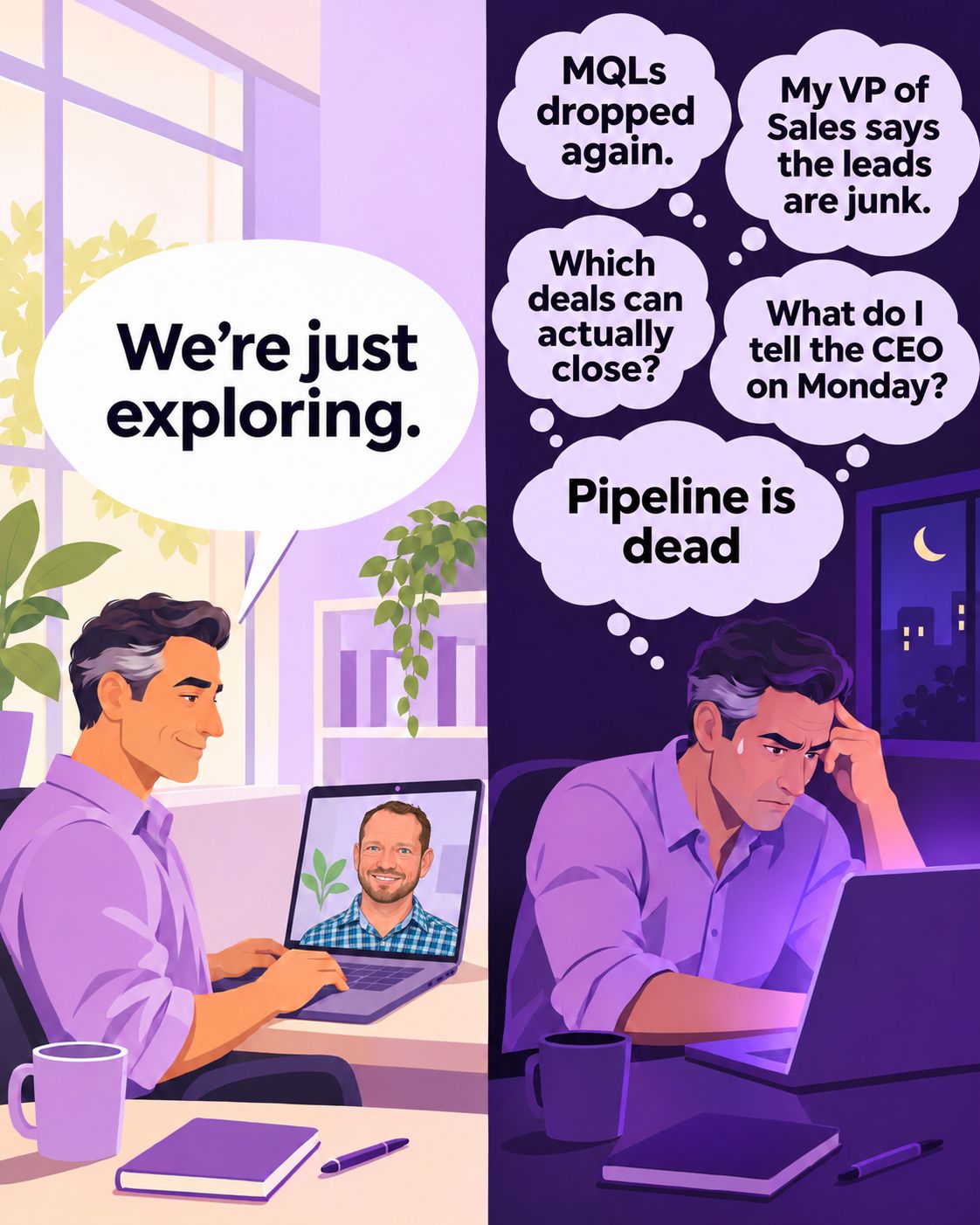
You don't show your hemorrhoids to the doctor who lives next door.
You google it at 2am. You read three forums. You ask ChatGPT questions you'd never say out loud. And only once you know what you're dealing with do you book an appointment, ideally with someone you'll never bump into at the supermarket.
B2B buyers are exactly the same.
Key takeaways
- On a first call with a sales rep, buyers say "we're just exploring." Polite, guarded, useless.
- The real pain comes out somewhere else: alone, anonymous, with no one selling to them.
- Most of your demand never shows up in your CRM. Buyers are interested. They just aren't ready to get undressed in front of a seller yet.
- With AI, it's different. You can be vulnerable, and it doesn't judge you.
- We're seeing a 63% increase in discovery depth when buyers talk to an AI agent instead of a rep.
- People share more when no one is selling to them.
Why don't B2B buyers tell sales reps their real problems?
B2B buyers don't tell sales reps their real problems because honesty in front of a seller has a price. On a first call with a sales rep, nobody says "our pipeline is a mess, my CEO is breathing down my neck, and I'm not even sure we have budget." They say "we're just exploring." Polite, guarded, useless.
A first call, often called a discovery call, is the conversation where a rep asks questions to understand the buyer's problem. The whole meeting depends on the buyer telling the truth. And the buyer has good reasons to hold back.
Admitting the problem means admitting a failure. "Our pipeline is a mess" is a confession, made to a stranger, on a recorded call.
Honesty weakens the buyer's hand. A rep who hears "my CEO is breathing down my neck" has just learned the buyer is under pressure. The buyer expects that to show up later in the price and the follow-ups.
Everything said gets written down. The buyer knows the answers are going into a system, and that the emails and calls afterwards will be built on them.
So the buyer puts on armor. "We're just exploring" commits to nothing and reveals nothing. The rep leaves with notes that say no pain, no timeline, no budget, and the deal is marked low priority. The buyer had all three. The rep just never heard about them.
Where do B2B buyers share their real pain?
B2B buyers share their real pain in places where nobody is watching and nobody is selling. The real pain comes out somewhere else: alone, anonymous, with no one selling to them. In practice that means a search bar late at night, a community thread, a review site, or a conversation with an AI tool.
The medical version maps onto the B2B version almost line for line:
| The patient | The B2B buyer |
|---|---|
| Googles it at 2am | Searches the problem long before searching for a vendor |
| Reads three forums | Reads communities, review sites and peer threads |
| Asks ChatGPT questions they'd never say out loud | Asks an AI tool the questions that would sound naive or desperate on a call |
| Books an appointment only once they know what they're dealing with | Talks to sales only once they understand their own problem |
Three conditions make the honesty possible. Alone means there is no audience to perform for. Anonymous means no name is attached to the question. No one selling means the answer has no consequences: no follow-up, no pressure, no record.
Buyers increasingly do this part of the work without a person in the room. In a Gartner survey of 645 B2B buyers run in August and September 2025, 45% had used generative AI during a recent purchase, mainly to research vendors and products, and 70% said they prefer a completely digital, self-service buying experience.
Why does most demand never show up in the CRM?
Most demand never shows up in the CRM because a CRM only records buyers who have identified themselves, and buyers put that off as long as they can. That's why most of your demand never shows up in your CRM. It's not that buyers aren't interested. They just aren't ready to get undressed in front of a seller yet.
A CRM, or customer relationship management system, is the database where a company tracks its leads, contacts and deals. A buyer enters it by doing something with a name attached: filling in a form, booking a call, replying to an email.
Everything before that moment is missing. The late-night search, the forum threads and the questions to ChatGPT leave no row in the CRM. And that hidden stretch is long. In 6sense's 2025 Buyer Experience Report, buyers were 61% of the way through their buying journey before they first contacted a seller.
So a CRM is a list of buyers who finally felt ready to be seen. It says very little about how many buyers have the problem. A thin pipeline gets read as weak demand, when the demand may be sitting one step outside the system, still deciding whether it is safe to speak.
Why do buyers share more with an AI agent than with a sales rep?
Buyers share more with an AI agent than with a sales rep because an AI agent doesn't judge them and isn't a person sitting across the table with a quota. And that's the kicker: with AI, it's different; you can be vulnerable, and it doesn't judge you!
This effect was measured long before AI sales tools existed. In a 2014 study from the University of Southern California's Institute for Creative Technologies, 154 people took part in a clinical-style interview with a virtual interviewer. Half were told it was fully automated. Half were told a person was operating it from another room. The people who believed they were talking to a computer reported less fear of disclosing personal information and less effort to manage the impression they made. That held whether or not a human was really behind it. What mattered was the belief that no person was watching.
That study was about health, which brings us back to the doctor next door. The same thing shows up in buying conversations.
In the data, it shows: we're seeing a 63% increase in discovery depth when buyers talk to an AI agent instead of a rep. Turns out people share more when no one is selling to them. How that trust gets built is a topic for another post :)
Discovery depth is how much a buyer reveals about their real situation in a conversation: the problem, the pressure behind it, the budget, the doubts. It is the exact material that "we're just exploring" keeps out of a first call. The number comes from our own data at Propello.
What would a buyer ask a vendor's AI that they'd never ask a sales rep?
A buyer would ask a vendor's AI the questions that feel too exposing to ask a person: the ones that reveal ignorance, a weak budget, internal politics or doubt. Those questions are where the real buying decision gets made, and a sales rep rarely hears them.
Some examples of what those questions sound like:
- "I don't fully understand what this kind of product does. Can you explain it like I'm new to this?"
- "Is this overkill for a team our size?"
- "What do your customers complain about most?"
- "I'm not sure we have budget. What's the cheapest way to start?"
- "My CEO thinks we can build this ourselves. Is he right?"
Every one of those is discovery gold. Each tells the vendor what the buyer knows, what the buyer fears and who else is involved. And every one is hard to say out loud to a person whose job is to sell you something.
On a sales call the buyer protects themselves and the rep gets "we're just exploring." Alone with an AI, the same buyer asks the real question, because nothing is at stake in asking it.
So be honest: what would you ask a vendor's AI that you'd never ask their sales rep?
FAQ
Why do buyers say "we're just exploring" on a first sales call?
Buyers say "we're just exploring" because the phrase commits to nothing and reveals nothing. Telling a sales rep that the pipeline is a mess, the CEO is applying pressure and the budget is uncertain feels risky. The answer is polite, guarded and useless to the rep.
Where do B2B buyers do their real research?
B2B buyers do their real research alone and anonymously, with no one selling to them. They search, read forums and review sites, and ask AI tools the questions they wouldn't say out loud. In 6sense's 2025 Buyer Experience Report, buyers were 61% of the way through their journey before first contacting a seller.
Why doesn't my CRM show all the demand for my product?
A CRM only records buyers who have identified themselves through a form, a call or an email. Buyers who are interested but not ready to talk to a seller leave no record. Most demand sits in that invisible stretch before first contact.
Do buyers share more with AI than with salespeople?
Yes. Propello is seeing a 63% increase in discovery depth when buyers talk to an AI agent instead of a rep. A 2014 University of Southern California study found that people who believed they were talking to a computer reported less fear of disclosing personal information.
What is discovery depth?
Discovery depth is how much a buyer reveals about their real situation in a conversation, including the problem, the pressure behind it, the budget and the doubts. A guarded first sales call has low discovery depth. A conversation where the buyer feels safe has more.