It's 2026. Buyers Research With AI. Then Click Your Website and Travel Back to 2006.

Omri PeledCo-Founder & CPO, Propello
Buyers now research software in a conversation with AI, where the answers come with context, relevance, and deep personalization. Then they click a vendor's website and have to navigate, search and piece everything together on their own. I think that gap is about to become a much bigger problem for SaaS companies.
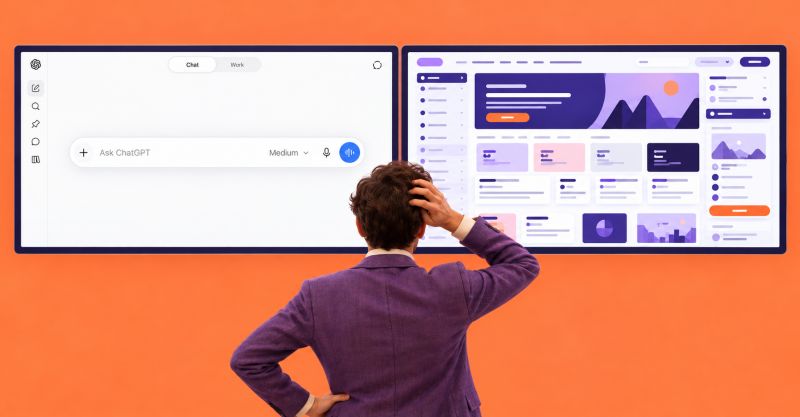
Navigating through a vendor's website after researching solutions on ChatGPT feels like going back in time.
It's like ordering a pizza on Uber Eats, choosing all the toppings, the crust, and the garlic breadsticks, and then calling the restaurant to give them your credit card details and address.
Key takeaways
- Buyers research with AI, then land on a vendor website that works the way websites did in 2006.
- Within a single user journey, buyers go from having answers handed to them to an outdated interaction model: traditional websites.
- AI isn't only changing how buyers learn about and discover products. It's completely changing their consumption habits.
- Asking a buyer to go from a conversational AI experience back to browsing a website is pure friction. Which means pain.
- The vendor experience needs to become as explorable as the AI experience that brought the buyer there.
- The web was built around navigation. AI is training us to expect conversation.
Why does a vendor website feel outdated after researching with AI?
A vendor website feels outdated after researching with AI because the buyer has just spent the first half of the journey being answered and now has to go looking. Within a single user journey, we go from having the answers we need handed to us with context, relevance, and deep personalization to suddenly being thrown back into an outdated interaction model: traditional websites.
An interaction model is the way a person gets what they need from a product. Clicking through menus is one model. Asking a question and getting an answer is another.
The pizza order shows what goes wrong. The hard part, all the choosing, happened in the modern interface. Then the last step drops to an older one, and you have to repeat things the system already knew.
Here is an example of the same thing in software buying. A head of operations asks ChatGPT which tools fit a 50-person team that needs a specific integration. ChatGPT gives a shortlist with reasons for each. The buyer clicks one vendor and lands on a homepage with a headline written for everyone. Everything the buyer just explained about the team, the integration and the budget is gone.
Nothing is handed to us anymore.
What does a traditional website make buyers do?
A traditional website makes the buyer do the work that AI was doing a minute earlier. A traditional website is a set of fixed pages, such as home, product, pricing and use cases, that every visitor reaches through the same menu. The buyer has to find the pages, read them, and connect the pieces.
Now we need to navigate.
Find the right page.
Read generic content.
Figure out pricing.
Find our use case.
Piece together everything.
The same buyer question gets two very different treatments:
| The buyer wants to know | In an AI conversation | On a traditional website |
|---|---|---|
| Does this fit my use case? | An answer about their case | A use-case page to find, written for a segment |
| What will it cost me? | An estimate based on what they said | A pricing page to interpret, or "contact sales" |
| How does it compare? | A side-by-side on the points they care about | Several pages and tabs to compare by hand |
| What should I look at next? | A follow-up question away | Back to the menu |
Generic content is the real cost. A page written for every visitor has to stay general, so the buyer does the translating. What does this mean for a company my size, in my industry, with my stack? The AI conversation had already answered that.
How is AI changing the way buyers consume information?
AI is changing what buyers expect from every screen, and that goes further than where they start their research. AI isn't only changing how we, as buyers, learn about and discover products. It's actually completely changing our consumption habits. Once a person gets used to asking and being answered, browsing starts to feel like work.
Imagine being forced to call a travel agent to book a flight. Seems absurd.
Nobody held a meeting and decided to stop calling travel agents. A better interface showed up, people got used to it, and the old way started to feel like a chore. The same thing is happening to websites right now, only faster.
The numbers say the habit is already here. In Forrester's Buyers' Journey Survey of nearly 18,000 global business buyers, fielded in 2025, 94% reported using AI during their buying process. A Gartner survey of 645 B2B buyers, run in August and September 2025, asked a narrower question and found that 45% used generative AI during a recent purchase, mainly to research vendors and products.
A consumption habit is the way a person is used to taking in information. Ours is moving from reading pages to asking questions. A habit learned in one place doesn't stay there. A buyer who asks ChatGPT ten questions before lunch brings that expectation to the next tab they open.
Why is the gap a growing problem for SaaS companies?
The gap between AI research and a traditional website is a growing problem for SaaS companies because it hits buyers at the moment they are most interested. A buyer who clicks through from an AI answer already knows what they want to check. The website then slows them down.
So why does asking buyers to move from an advanced conversational AI experience back to browsing through a website seem okay?
This is pure friction. Which means pain.
Friction is any extra effort between a buyer and the thing they came for. On a website it shows up as one more click, one more page, one more form. Each of those is a point where a buyer can leave. And the AI conversation they came from is still open in the next tab, where a competitor is one question away.
Buyers also want to do this part on their own. In the same Gartner survey of 645 B2B buyers, 70% said they prefer a completely digital, self-service buying experience. If most of the buying happens in self-service, the website carries most of the weight. A website that makes buyers dig is failing at the main job it has.
We're experiencing an accelerated paradigm shift, and companies need to adapt quickly. The longer buyers spend with conversational AI, the wider the gap feels when they leave it.
What should the vendor experience look like for buyers who arrive from AI?
The vendor experience needs to become as explorable as the AI experience that brought the buyer there. Explorable means the buyer sets the path. They ask what they want to know, in their own words and their own order, and the experience responds to that instead of sending them through a menu.
Ask a question -> Get a real answer -> See the relevant product -> Go deeper when you want.
Each step replaces something a traditional website leaves to the buyer:
- Ask a question. The buyer starts with what they care about, the same way they started in ChatGPT. No hunting for the right page.
- Get a real answer. A real answer is specific to the question and the buyer's situation. A link to a page that might contain the answer doesn't count.
- See the relevant product. The buyer sees the part of the product that matters to their question, next to the answer. They don't sit through a tour of every feature to find it.
- Go deeper when you want. Pricing, security, integrations and edge cases are there when the buyer asks for them, and stay out of the way until then.
A quick test for any SaaS website: take the last five questions buyers asked on sales calls and try to get each one answered on the site without talking to anyone. Count the clicks. Then ask the same five questions in ChatGPT and compare how the two felt.
The web was built around navigation.
AI is training us to expect conversation.
And the gap between those two experiences is becoming impossible to ignore.
FAQ
Why do B2B websites feel outdated to buyers in 2026?
B2B websites feel outdated in 2026 because buyers arrive from AI tools like ChatGPT, where answers are handed to them with context and personalization. A traditional website asks the same buyer to navigate, find the right page and piece everything together. The contrast inside one journey is what makes the website feel like 2006.
How are B2B buyers using AI to research software?
B2B buyers use AI to learn about, discover and compare products before they visit a vendor. In Forrester's 2025 Buyers' Journey Survey of nearly 18,000 business buyers, 94% reported using AI during their buying process. Gartner found that 45% of 645 B2B buyers used generative AI during a recent purchase.
What is the gap between AI research and vendor websites?
The gap is the drop in experience when a buyer moves from a conversational AI tool to a traditional website. In the AI conversation, the buyer asks and gets an answer. On the website, the buyer has to navigate, read generic content and figure out pricing and use cases alone.
What is an explorable vendor experience?
An explorable vendor experience lets the buyer set the path. The buyer asks a question, gets a real answer, sees the relevant product, and goes deeper when they want. It works the way the AI experience that brought the buyer there works.
Why should SaaS companies care about website friction now?
SaaS companies should care now because AI is changing buyers' consumption habits, and habits carry over to every screen. Asking a buyer to go from an advanced conversational AI experience back to browsing a website is pure friction. Which means pain.