A Buyer Can Visit 10 Pages, Download 3 Docs, and Understand Nothing

Omri PeledCo-Founder & CPO, Propello
A buyer can visit 10 pages, download 3 docs, and understand nothing. Somehow, we call that progress. Traditional GTM metrics count what a buyer did. None of them tell us how much closer that buyer is to taking the next step.
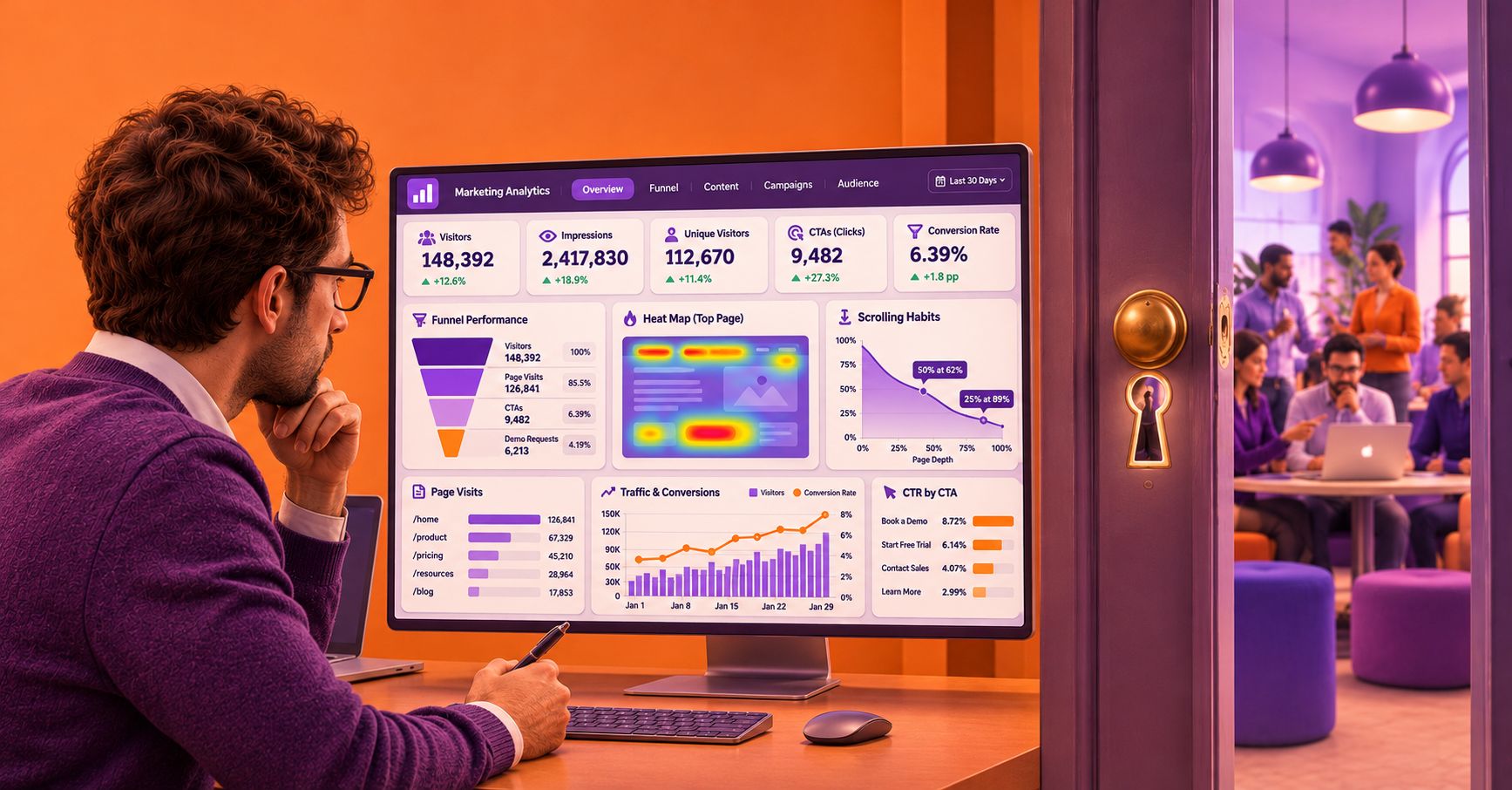
This post is about that blind spot at the top of the funnel: what we measure, what buyers are really doing, and why the two rarely meet.
Key takeaways
- Clicks, impressions, duration, conversions, page views, scrolling patterns, heat maps and spend are vanity metrics. They record activity.
- Buyers aren't trying to move through our imaginary funnels. They don't even know there's a funnel.
- Buyers learn by moving back and forth, up and down, sideways. They start. Stop. Start again.
- There is no "buyer playbook". Buyers are just trying to reduce uncertainty until they're confident enough to take the next step.
- None of the traditional metrics tell us how much progress a top-of-the-funnel buyer has actually made.
- If we can't see buyer progress, we can't influence it.
What are vanity metrics in a GTM dashboard?
Vanity metrics in a GTM dashboard are numbers that count buyer activity without showing whether the buyer understood anything. A vanity metric is easy to collect and looks good in a report, but it doesn't tell a team whether the thing they care about happened. GTM, or go-to-market, is the work of bringing a product to buyers.
We showcase a GTM dashboard packed with activity—clicks, impressions, duration, conversions, page views, scrolling patterns, heat maps, and spend.
These are what I like to call vanity metrics.
We deduce, iterate, and test. And it looks great in weekly reports and funnel dashboards.
Look at what each number on that list records. Every one is either something the buyer did or something we paid for. A click is an action. Duration is time on a page. Spend is our money. Not one of them records a change in what the buyer knows.
Here is an example. Two buyers each visit 10 pages and download 3 docs. The first one skimmed everything to confirm a decision already made. The second one read every word and left more confused than before. In the dashboard they are the same row. Same page views, same downloads, same lead score. One is ready for a conversation. The other understood nothing.
Do B2B buyers actually move through a funnel?
No. B2B buyers don't move through a funnel, because the funnel is the seller's model and the buyer has never seen it. A funnel is a diagram that sorts buyers into ordered stages, from awareness at the top to purchase at the bottom. Buyers don't learn in ordered stages.
But here is the honest truth: Buyers aren't trying to move through our imaginary funnels.
They don't even know there's a funnel.
They learn by moving back and forth, up and down, sideways. They start. Stop. Start again.
The funnel is our accounting system. The "stage" a buyer is in is a label we assign from the outside, based on the last thing they clicked. The buyer experiences a pile of questions, and the pile grows and shrinks in no particular order.
The research on B2B buying describes the same mess. Forrester's State of Business Buying, 2024, based on a survey of more than 16,000 global business buyers, found that 13 people inside the organization are involved in an average buying decision and that the large majority of purchases stall at some point. A Gartner survey of 645 B2B buyers run in August and September 2025 found buyers used an average of seven information sources during a recent purchase. Thirteen people, seven sources and regular stalls don't produce a straight line.
What does top-of-the-funnel exploration really look like?
Top-of-the-funnel exploration looks like a loop with long pauses in it. A buyer orients, gets confused, asks an AI tool, compares, gets distracted, asks other people, finds a new concern and goes back to the start. Most of it happens in places a vendor's dashboard never sees.
Here's what top-of-the-funnel exploration looks like:
- Orient. Get confused. Ask ChatGPT. Think you get it.
- Explore. Get distracted. Disappear for two weeks.
- Compare. Check G2. Get targeted on LinkedIn.
- Book three demos. Cancel one. Miss one. Watch one.
- Read a thought leader's post. Question everything.
- Ask a colleague. Get another conflicting answer.
- Discover a new concern. Back to ChatGPT.
- Contact vendors. Get overwhelmed. Stop.
- Decide. Ask your boss. Start over.
Three things stand out in that list.
The buyer loops. "Back to ChatGPT" and "Start over" send the buyer to an earlier point. A funnel has no arrow that points up.
The buyer pauses. "Disappear for two weeks" reads as a dead lead in a dashboard. For the buyer it was a busy fortnight, and the question is still open.
Other voices keep changing the picture. ChatGPT, G2, LinkedIn, a thought leader, a colleague and a boss all weigh in. The vendor's website is one stop among many, and the vendor's analytics only cover that one stop.
That last point is measurable. In 6sense's 2025 Buyer Experience Report, buyers first contacted a seller when they were 61% of the way through their buying journey. In 6sense's earlier studies the figure was 69%. Either way, more than half of the journey is over before a seller hears from the buyer.
What are buyers trying to do, if they aren't following a funnel?
Buyers are trying to reduce uncertainty. Unlike sales, there is no "buyer playbook". Buyers are just trying to reduce uncertainty until they're confident enough to take the next step. Buyer progress, then, is a change in confidence. A count of pages visited says nothing about it.
Sales has a playbook. A playbook is a defined sequence of stages, each with a script and a condition for moving on. A seller always knows which step comes next.
A buyer has a list of open questions, and the list keeps changing. Is this problem worth solving now? Which kind of product solves it? Will it work with what we have? What will my boss say? The buyer takes the next step when enough of those questions feel settled.
Read the exploration list again with that in mind. Some moves reduce uncertainty: "Ask ChatGPT. Think you get it." Some moves add it: "Get another conflicting answer." "Discover a new concern." "Question everything."
So activity can be progress, no progress, or progress in reverse. The buyer who visits 10 pages and downloads 3 docs may have ended the session with more open questions than at the start. The dashboard still shows 13 touchpoints and calls it engagement.
Why can't traditional metrics measure buyer progress?
Traditional metrics can't measure buyer progress because they record actions, and buyer progress is a change in understanding and confidence. The problem is that we lack the metrics to accurately capture and describe that progress over time.
And if we can't see it, we can't influence it.
Right now, none of the traditional metrics tell us how much progress a top-of-the-funnel buyer has actually made toward taking the next step.
What we have are correlations. A correlation means two things tend to show up together. Causality means one of them produced the other. Dashboards are full of the first and almost empty of the second.
Here is a common example. Buyers who view the pricing page convert at a higher rate. Did the pricing page move them forward? Or do buyers who have already made up their minds go and check the price? The dashboard can't tell the two stories apart. We pick the one we like, send more traffic to the pricing page, and wait.
A metric that described buyer progress would have to answer different questions than the ones dashboards answer today:
- What does this buyer understand now that they didn't understand before?
- Which of their questions are still open?
- How confident are they about taking the next step?
None of the eight numbers on the GTM dashboard answers any of them. So we keep deducing, iterating and testing on top of activity, and we keep treating the result as insight.
We're bound to a reality of correlations, almost never reaching real causality, and we keep making guesstimations and educated wishes :)
FAQ
What are vanity metrics in B2B marketing?
Vanity metrics in B2B marketing are numbers that count activity without showing buyer progress. Clicks, impressions, duration, conversions, page views, scrolling patterns, heat maps and spend all look great in weekly reports and funnel dashboards. None of them shows whether a buyer understood anything.
Is the B2B marketing funnel accurate?
The B2B marketing funnel describes how sellers organize their reporting. It doesn't describe how buyers behave. Buyers don't even know there's a funnel. They learn by moving back and forth, up and down, sideways, and they start, stop and start again.
What does the top-of-the-funnel buyer journey look like?
The top-of-the-funnel buyer journey is a loop with pauses. A buyer orients, gets confused, asks ChatGPT, checks G2, books demos, asks a colleague, discovers a new concern and goes back to ChatGPT. In 6sense's 2025 Buyer Experience Report, buyers were 61% of the way through the journey before first contacting a seller.
What is buyer progress?
Buyer progress is a reduction in uncertainty. Buyers are trying to reduce uncertainty until they're confident enough to take the next step. A buyer can visit 10 pages and download 3 docs and make no progress at all.
Why is it hard to measure buyer progress?
Buyer progress is hard to measure because traditional metrics record actions, and progress is a change in what the buyer understands. That leaves GTM teams with correlations and almost never with causality. If a team can't see buyer progress, the team can't influence it.